
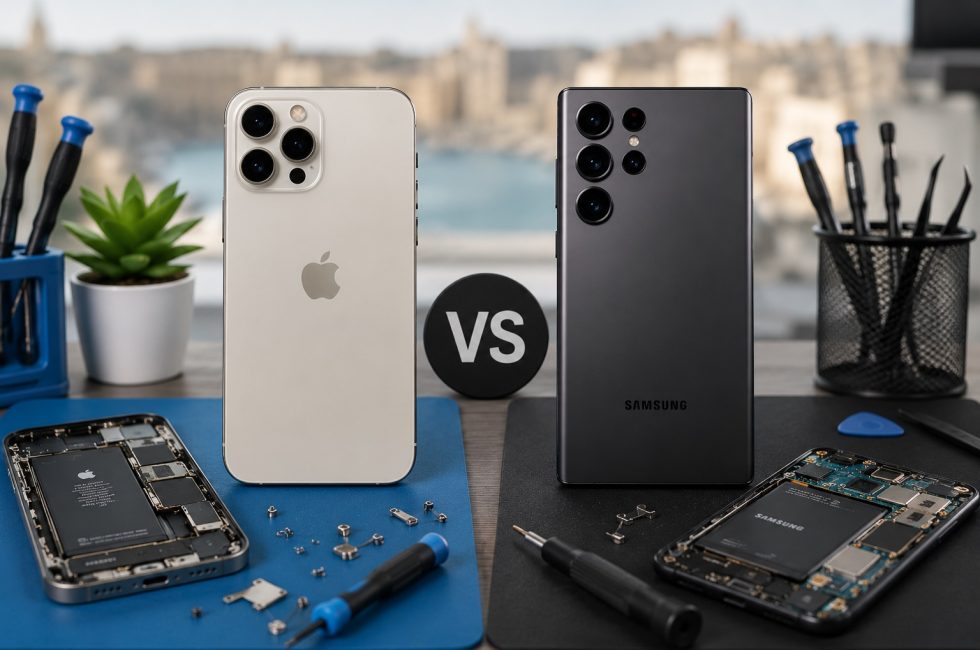
Choosing between iPhone and Samsung isn’t just about cameras and operating systems — it’s about what happens when you drop it. Repair costs, parts availability, and repairability vary significantly between Apple and Samsung devices. Here’s the comparison from a repair professional’s perspective in Malta.
Repairability scores: Samsung is improving, Apple is Apple
iFixit, the repair advocacy group, scores phones on repairability from 1 (impossible) to 10 (easy). Recent iPhone models score 4-7 depending on the generation. Samsung flagships hover around 4-6, though Samsung has made genuine improvements in the last two years with pull-tab batteries and modular component design.
The practical difference? Both brands require heat and careful prying to open. Both use strong adhesive that needs replacing during reassembly. Both have components (batteries, screens) that are fundamentally replaceable by a skilled technician. Neither brand makes it easy for DIY repairs, but both are routine for a professional shop.
Screen repair: iPhone tends to be simpler
iPhone screens through the iPhone 14 series are flat glass panels — straightforward to remove and replace. The iPhone 15 and 16 series continue this design. The display connector is accessible once the phone is open, and the component transfer (earpiece speaker, sensor array) follows a consistent procedure across models.
Samsung flagships (S23, S24, and Ultra models) use curved-edge AMOLED displays that are more delicate to handle. The curved glass means adhesive must be applied precisely, and the ultrasonic fingerprint sensor (embedded under the screen on S-series models) requires calibration after a screen swap. These are not harder per se, but they add steps and cost.
Battery replacement: Samsung is easier (on recent models)
Samsung has moved to pull-tab battery adhesive on recent models (S23 onwards), making battery swaps significantly easier. The tabs release cleanly and the battery lifts out without the prying and solvent that older designs required. Apple still uses stretch-release adhesive strips that can snap during removal, requiring careful isopropyl alcohol application to dissolve the remaining adhesive — not difficult, but messier.
Charging port: iPhone is easier
iPhone Lightning ports are integrated into a flex cable assembly that’s relatively straightforward to replace. Samsung USB-C ports are soldered to the main board or a sub-board, requiring micro-soldering skills for replacement. This makes Samsung charging port repairs slightly more involved — and therefore slightly more expensive — than iPhone equivalents.
Parts availability in Malta
Both iPhone and Samsung parts are widely available through European distributors. We stock screens and batteries for current models of both brands in our Hamrun workshop. Older or less common models may require ordering — typically 2-3 days from EU suppliers. There’s no meaningful difference in parts availability between the two brands for current-generation devices.
Common failure points by brand
iPhone: Cracked back glass (models before iPhone 15 Pro), worn Lightning ports, degraded batteries after 2+ years, Face ID sensor failure from drops.
Samsung: Cracked curved AMOLED panels, USB-C port looseness, camera OIS failure from drops, screen burn-in on older AMOLED panels.
The bottom line
For screen repairs, iPhone is marginally cheaper and simpler. For battery replacements, both brands are comparable with Samsung’s recent pull-tab design being slightly more technician-friendly. For charging ports, iPhone has the edge. Across all repair types, both brands are well-supported in Malta with parts, tools, and expertise.
The real cost comparison isn’t iPhone vs Samsung — it’s manufacturer service vs independent repair. Going through Apple or Samsung officially costs 40-60% more than a quality independent shop using OEM-grade parts, regardless of which brand you own.